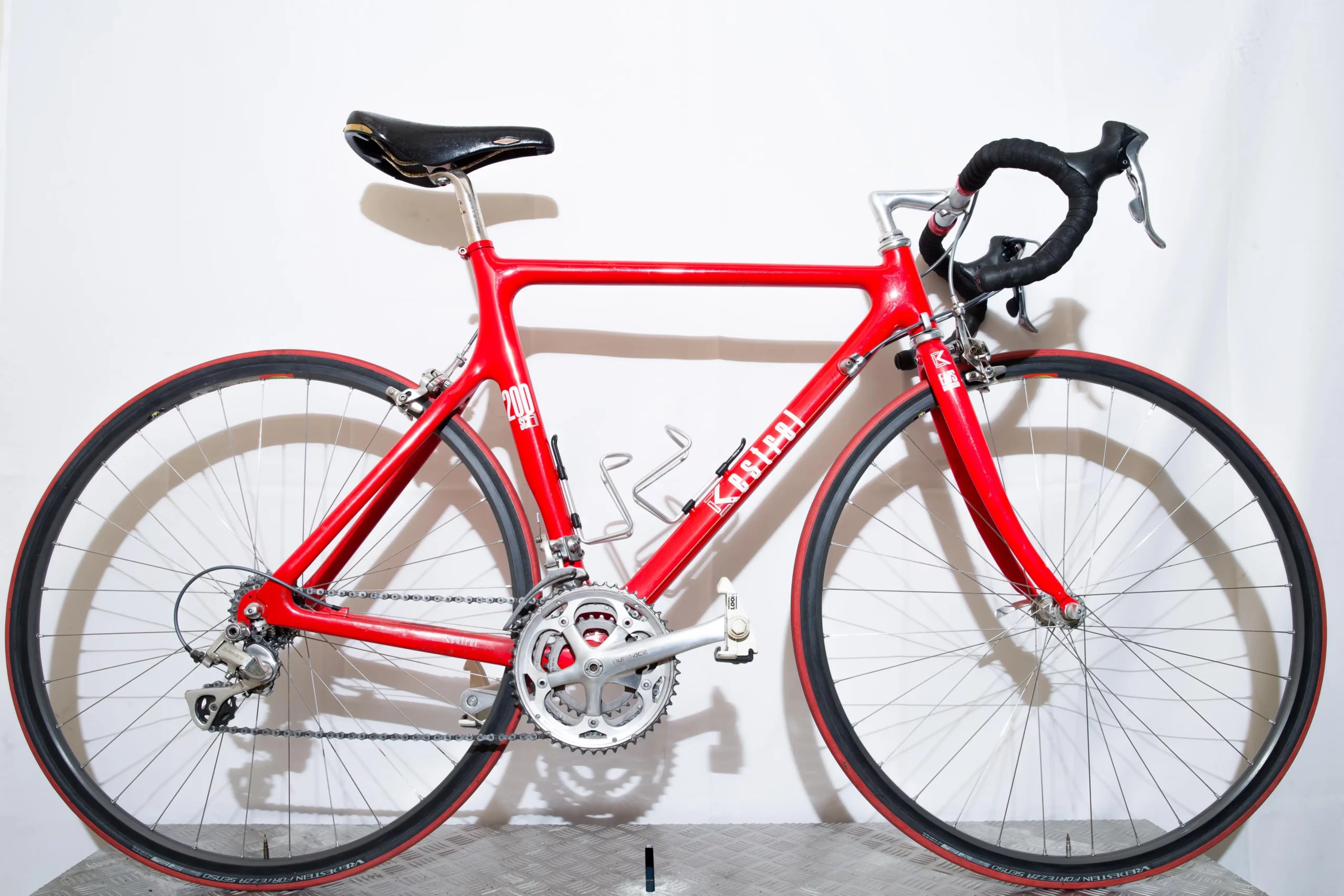


We are proud to present in our Flandrien Gallery the Kestrel 200, a landmark bicycle in the evolution of carbon frame technology and modern road cycling design. Fitted with first-generation Shimano Dura-Ace STI components, this bike represents a pivotal moment in the sport when integrated shifting, lightweight construction, and aerodynamic considerations began to redefine what a racing bicycle could be.
Kestrel has long been recognized as a pioneer of carbon frame technology. In the 1980s and 1990s, the company was at the forefront of experimenting with advanced composite materials, producing some of the first fully carbon monocoque frames for road racing. The Kestrel 200 embodies this innovative spirit, combining lightweight carbon construction with geometry optimized for both speed and control. Its design marked a significant shift in bicycle engineering, moving away from traditional aluminium and steel frames and towards the possibilities offered by composites—enhancing stiffness, weight reduction, and ride efficiency.
Fitted with Shimano’s first-generation Dura-Ace STI (Shimano Total Integration) components, the Kestrel 200 introduced integrated shift and brake levers to a generation of riders accustomed to separate mechanisms. This technology allowed cyclists to change gears without removing their hands from the handlebars, a revolutionary advancement that improved safety, efficiency, and performance. Paired with the ultra-light frame and precise geometry of the Kestrel 200, the STI system ensured seamless power transfer and responsive handling, offering a ride experience that was at the cutting edge of professional cycling in its era.
The Kestrel 200’s frame geometry reflects a forward-thinking approach to both rider ergonomics and aerodynamics. Designed to optimize power delivery while maintaining stability and control, it allowed riders to push harder with confidence on climbs, descents, and flat stretches alike. Its sleek lines and clean integration of components highlighted the potential of carbon as a material, demonstrating that bikes could be both visually striking and functionally superior.
This particular example in the Flandrien Gallery remains in pristine condition, preserving its original first-generation Dura-Ace STI components. Every detail—from the frame’s composite layup to the ergonomically shaped levers—illustrates the pioneering engineering that made Kestrel a household name among early adopters of carbon technology. For collectors and enthusiasts, it is a rare opportunity to experience a machine that bridges the gap between traditional racing bikes and the modern era of high-performance composites.
The Kestrel 200 is more than just a technological milestone; it is a symbol of innovation and vision in the cycling world. It represents the moment when material science, integrated shifting, and aerodynamic design converged to change the trajectory of road bicycle development forever. Owning this bicycle is not only about performance—it is about celebrating the ingenuity and daring of a brand that challenged conventional thinking and helped shape the bicycles we ride today.
In short, the Kestrel 200, fitted with first-generation Shimano Dura-Ace STI components, is a historically significant and highly collectible machine. It showcases Kestrel’s pioneering role in carbon frame technology, introduces the revolutionary concept of integrated shifting, and exemplifies a moment of profound innovation in bicycle design. For enthusiasts, collectors, and riders, this bicycle is both a piece of cycling history and a tangible reminder of how engineering vision can redefine an entire sport.